
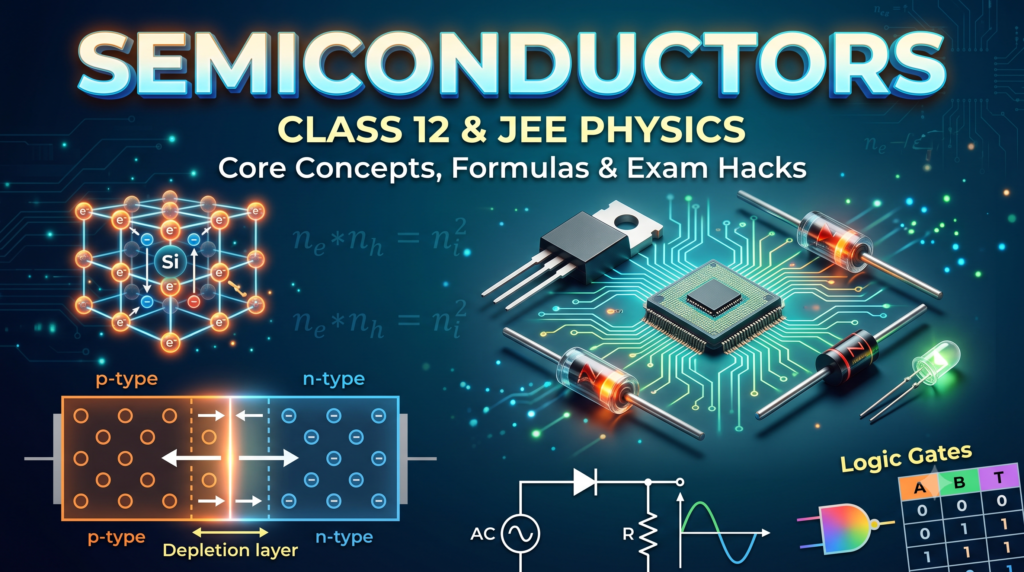
Semiconductors form the foundation of modern electronics, powering everything from smartphones to solar panels. For Class 12 students, this chapter is a highly scoring topic in competitive exams like JEE Main and BSc Physics. This guide breaks down the core concepts, essential formulas, and frequently tested points. The topics covered under semiconductor section is discussed here. This is introductory section on semiconductor. The brief introductory material is given here. There will be series of articles on this topic of semiconductor posted here in this website.
Conductors, Insulators, and Semiconductors
Solids are classified by their electrical conductivity, which depends on their energy bands.
• Conductors (e.g., copper, silver): Valence and conduction bands overlap, allowing electrons to move freely. Resistivity is roughly 10⁻⁸ to 10⁻⁶ Ω·m.
• Insulators (e.g., diamond, glass): A large band gap (above 3 eV) prevents electrons from reaching the conduction band.
• Semiconductors (e.g., silicon, germanium): A small band gap (about 1.12 eV for Si and 0.67 eV for Ge) allows some electrons to be thermally excited into the conduction band.
Key Feature: Unlike metals, where resistance rises with temperature, a semiconductor’s resistance falls as temperature increases because more electrons are excited across the gap.
Intrinsic and Extrinsic Semiconductors
Intrinsic Semiconductors : A pure semiconductor with no added impurities. At 0 K, it acts as an insulator. At room temperature, thermal energy creates equal numbers of electrons (nₑ) and holes (nₕ), so nₑ = nₕ = nᵢ.
Extrinsic Semiconductors (Doping) Adding a small amount of a trivalent or pentavalent impurity significantly alters carrier concentration.
• n-type: Doped with a pentavalent atom (P, As, Sb). Electrons are the majority carriers.
• p-type: Doped with a trivalent atom (B, Al, In). Holes are the majority carriers. The law of mass action holds for any semiconductor: nₑ · nₕ = nᵢ².
Junctions
The p-n Junction When p-type and n-type regions are joined, electrons diffuse from n to p, and holes diffuse from p to n. This creates a depletion layer with a barrier potential (about 0.7 V for silicon and 0.3 V for germanium).
• Forward Bias: The p-side is connected to the positive terminal. Current rises steeply once the voltage exceeds the barrier potential.
• Reverse Bias: The n-side is connected to the positive terminal. The depletion layer widens, allowing only a tiny reverse saturation current to flow.
Rectifiers: Converting AC to DC A diode allows current to pass in only one direction, making it useful for converting alternating current (AC) to direct current (DC).
• Half-Wave Rectifier: Uses 1 diode; maximum efficiency is 40.6%.
• Full-Wave Rectifier: Uses 2 or 4 diodes; maximum efficiency is 81.2%.
Diodes
Zener Diode as a Voltage Regulator A Zener diode operated in reverse breakdown maintains a nearly constant voltage, making it an effective voltage regulator. It must be connected in series with a current -limiting resistor. Without it, the diode will draw excessive current and destroy itself.
Special Diodes
• Light-Emitting Diode (LED): Releases energy as light when electrons recombine with holes in forward bias.
• Photodiode: Operated in reverse bias; absorbed light creates electron-hole pairs, generating a current proportional to light intensity.
• Solar Cells: These opeate on the same principles of Photodiode but in an unbiased state.
• Logic Gates : Diodes and transistors are combined to build logic gates. NAND and NOR are considered universal gates because any other logic gate can be built from them.
Important Points for Exams
• Silicon barrier potential is ~0.7 V; germanium is ~0.3 V.
• Semiconductor resistance decreases with temperature.
• Half-wave rectifier efficiency is 40.6%; full-wave is 81.2%.
• A Zener diode regulates voltage only in reverse breakdown.
For any clarifications contact us at : https://mathsnscience.com/contact/
You can see the videos on various physics topics in you tube channel maths&science by iitian available at link :
https://www.youtube.com/@mathsciencebyiitian
Related Articles & Resources
Kirchoff Law – KCL and KVL | Current and Electricty-1
Kirchoff law, Kirchoff Current Law (KCL), and Kirchoff Voltage Law (KVL) are discussed in this section…
Read articleQuantum Mechanics – Newtonian Mechanics Comparison
Quantum mechanics differs from Newtonian Mechanics in various aspects. These differences between the Quantum Mechanics and…
Read articleBohr Model Hydrogen Atom: Energy Transitions from Balmer Series to Lyman Series
Bohr Model Hydrogen Atom is a very important topic in Modern Physics. In this article…
Read article