
Kirchoff Law – KCL and KVL | Current and Electricty-1
Also in: JEE Physics Electromagnetism Current Electricity NEET Physics Electrodynamics Current Electricity BSc Physics Electromagnetism Electrostatics Physics Olympiad INPhO Current and Electricty
PhysicsBSc PhysicsJEE PhysicsNEET PhysicsPhysics Class 12Physics OlympiadCurrent and ElectrictyCurrent and ElectrictyCurrent ElectricityCurrent ElectricityCurrent ElectricityElectrostaticsKirchoff law, Kirchoff Current Law (KCL), and Kirchoff Voltage Law (KVL) are discussed in this section of Current Electricity -1 for JEE , CBSE, Olympiad Physics, CSIR, BSc Physics, INPhO and other examinations aspirants and the Physics enthusiast.
Here we will be discussing the definitions, concepts, applications, limitations and a practical problem is solved for clarity. Let us consider a simple electric circuit and discuss various concepts Kirchoff Law applications. We try to understand it from basics step by step from the given problem statement and circuit.
Kirchoff Law – Problem Statement
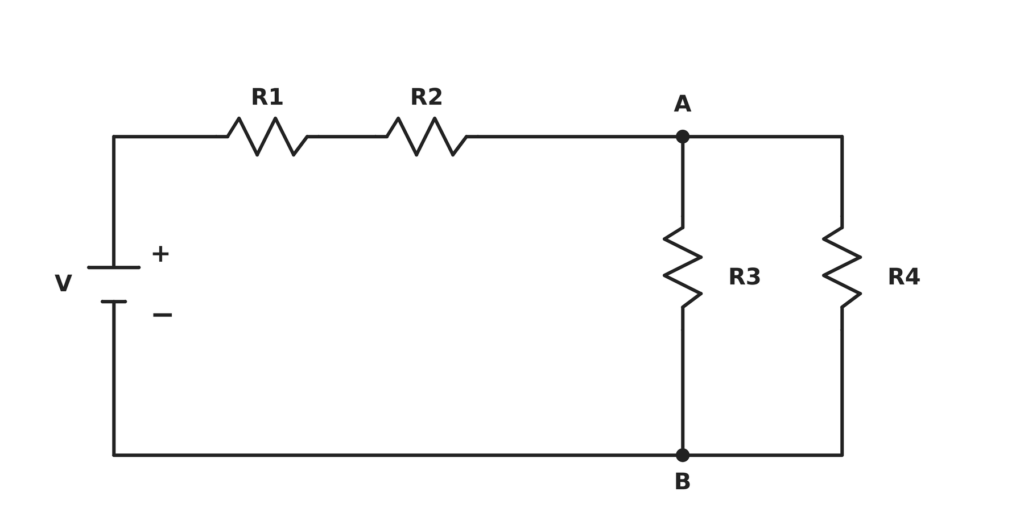
Study and analyze the below electrical circuit to find the currents in the circuit flowing through the resistances. The circuits is given as below. Explain the steps in solving the circuit starting from definitions to application of kirchoff law.
Solution
Understanding the circuit
Let us understand the circuit before proceeding for analyzing and applying the Kirchoff Law.
In the above circuit V = Voltage ( Source of power ) = Battery ( Example)
R1,R2,R3, and R4 are the resistances in the circuit.
A and B are the nodes. The definition of node is the point where three or more wires join.
The branch is the path between two nodes with one current. Hence A-R1-R2 -B = 1st branch,
A-R3-B = 2nd branch, A-R4-B = 3rd branch.
Hence there are 3 branches in the above circuit.
The resistances R1 and R2 are connected in series as connected one after the other along the same wire.
The resistances R3 and R4 are connected in parallel.
Finding the unknowns
The unknowns are ,
- Current in the battery and through the resistances R1 and R2 connected in series will be same . Let it be I.
- let the current through R3 be I3
- Let the current through R4 be I4
Hence number of unknowns = 3.
Number of branches = 3.
Application of Kirchoff Current Law (KCL)
As per Kirchoff Current Law (KCL), the amount of Inward current at a node = Outward Current at that node.
Let us consider the node A.
The Current moving towards node A = I
Current moving outwards of A = I3+I4
Hence at node A,
I= I3+I4
Application of Kirchoff Voltage Law ( KVL )
There are two Loops, One loop is B-V-R1-R2-A-R3-B and
second loop is A-R3-B-R4-A
As per Kirchoff law, The KVL stipulates that the net Voltage in a loop is zero.
Hence in first loop, V-IR1-IR2-I3R3=0.
From above, V= I(R1+R2)+I3R3
By considering the second loop we get,
-I3R3+I4R4=0.
Hence I3R3=I4R4
Application of Kirchoff Law ( Combining both KCL and KVL )
By combining the eqations obtained from both KCL and KVL as above,
I4=I3R3/R4
I= I3+I4=I3+I3R3/R4=I3( 1+R3/R4)
Hence by substituting above values in V= I(R1+R2)+I3R3, we get,
V=I3( 1+R3/R4)(R1+R2)+I3R3 = I3( R4+R3)(R1+R2)/R4+I3R3
From above,
VR4= I3[(R1+R2)(R3+R4) + R3R4]
Final Answer
From the above , we get the final answers for unknown currents as below,
I3=VR4/(R1R3+R1R4+R2R3+R2R4+R3R4)
I4= VR3/(R1R3+R1R4+R2R3+R2R4+R3R4)
I=I3+I4 = V(R3+R4)/(R1R3+R1R4+R2R3+R2R4+R3R4)
Conclusion
As above using the Kirchoff Law , KCL and KVL , the values of unknowns in the electrical circuit can be calculated from the given known values. In the above practice problem, the Voltage and Resistances are known. We found out the unknown currents in the circuit using the kirchoff Law.
For Physics video lectures vsit the Yo tube channel , maths&science by iitian at link :
https://www.youtube.com/@mathsciencebyiitian
For any clarifications on above article please write to us at:
https://mathsnscience.com/contact/
Related Articles & Resources
Quantum Mechanics – Newtonian Mechanics Comparison
Quantum mechanics differs from Newtonian Mechanics in various aspects. These differences between the Quantum Mechanics and…
Read articleBohr Model Hydrogen Atom: Energy Transitions from Balmer Series to Lyman Series
Bohr Model Hydrogen Atom is a very important topic in Modern Physics. In this article…
Read articleSpecial Relativity- Calculating Momentum from Relativistic Kinetic Energy
Special Relativity -Mass-Energy Equivalence, Relativistic Kinetic Energy, Momentum conservation,Special theory of Relativity mentioned in Einstein Relativity.
Read article